

Plain Labels in Dubai: Blank Self-Adhesive & Thermal Printer Labels
Discover high-quality plain labels in Dubai for barcode, shipping, inventory and thermal printing. Choose paper, PP, PET or vinyl with flexible adhesive options.
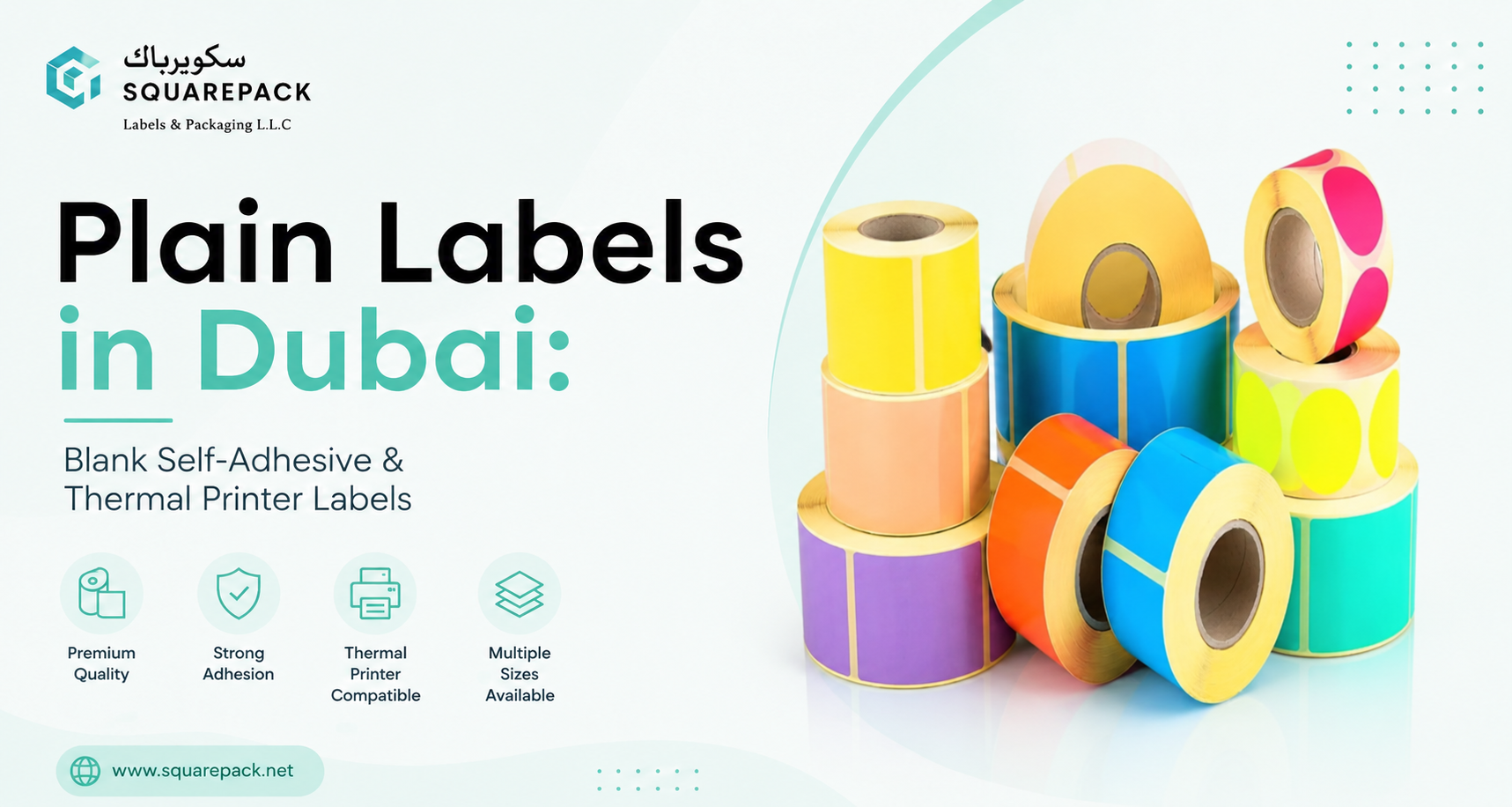
Plain Labels in Dubai: A Complete Guide to Blank Self-Adhesive and Thermal Printer Labels
Businesses that handle products, inventory, shipping, warehousing or barcode printing need labels that are reliable, easy to print and suitable for their working environment. While printed branding labels are useful for product presentation, plain labels provide businesses with the flexibility to print variable information whenever it is needed.
From barcode and inventory identification to shipping, product coding and warehouse management, blank labels can support a wide range of daily business operations.
For companies looking for plain labels in Dubai, choosing the right material, adhesive, size, roll configuration and printer compatibility is important. A label that works perfectly in a warehouse may not be suitable for a freezer, outdoor environment or a curved surface.
This guide explains what plain labels are, how they work, which materials and adhesives are available, and how to select the right option for your business.
Table of Contents
- → What Are Plain Labels?
- → Why Do Businesses Use Plain Labels?
- → Plain Labels for Thermal Printers
- → Choosing the Right Plain Label Material
- → Selecting the Right Adhesive
- → Common Applications of Plain Labels
- → What Should You Check Before Ordering Plain Labels?
- → Why Label Quality Matters
- → Plain Labels vs Pre-Printed Labels
- → How to Choose Plain Labels in Dubai
- → Get the Right Plain Labels for Your Business
What Are Plain Labels?
Plain labels are blank adhesive labels supplied without pre-printed text, graphics or barcodes. They are designed to be printed on demand using compatible label printers.
Unlike pre-printed labels, blank labels allow businesses to change the information printed on every label. This makes them particularly useful for barcodes, product identification, shipping information, inventory numbers, prices, batch information and other variable data.
Depending on the application, plain labels can be produced using materials such as paper, polypropylene (PP), polyester (PET) and vinyl. Adhesive options can also vary, including permanent, removable and freezer-grade adhesives.
For businesses that need flexible labeling solutions, plain self adhesive labels can be an efficient option because they combine printable surfaces with easy application.
Why Do Businesses Use Plain Labels?
The main advantage of blank labels is flexibility.
A business may need to print different product codes, barcodes, quantities or shipping information every day. Ordering individually printed labels for every variation can be inconvenient. Plain labels allow the business to keep a suitable stock of blank labels and print information when required.
Some common advantages include:
1. On-Demand Printing
Businesses can print information whenever it is needed instead of ordering pre-printed labels for every product or process.
2. Variable Information
Barcode numbers, SKU codes, prices, batch numbers, serial numbers and other changing information can be printed as required.
3. Inventory Management
Blank barcode labels can help businesses identify products, shelves, cartons, assets and inventory locations.
4. Flexible Applications
Plain labels can be used across retail, logistics, warehousing, manufacturing, e-commerce, pharmaceuticals and other industries.
5. Multiple Material Options
Different materials can be selected depending on durability, surface type and environmental conditions.
Plain Labels for Thermal Printers
One of the most important considerations when buying blank labels is printer compatibility.
Plain labels can be designed for different printing technologies, including thermal transfer and direct thermal printing. Selecting the correct label for the printer helps achieve clear and reliable output.
Thermal transfer labels use a ribbon to transfer ink onto the label surface. This printing method is commonly used when businesses require durable printed information.
Direct thermal printing, on the other hand, uses heat-sensitive material and does not require a ribbon.
Before ordering labels, businesses should check their printer model, printing method, label dimensions, core size and roll configuration.
SquarePack's plain labels are designed for thermal transfer and direct thermal printing applications and are compatible with major thermal printer brands, including Zebra, TSC and Honeywell.
Choosing the Right Plain Label Material
The material of a label affects its durability, appearance and suitability for different environments.
Paper Labels
Paper is a practical choice for many indoor applications where extreme moisture, chemicals or abrasion are not major concerns.
Paper plain labels can be suitable for general barcode printing, identification, inventory and warehouse applications.
Polypropylene (PP) Labels
Polypropylene provides greater durability than standard paper and can be useful where resistance to moisture and handling is important.
PP labels can be considered for applications involving products, packaging and environments where additional durability is required.
Polyester (PET) Labels
Polyester labels are suitable for applications that demand higher durability and resistance.
They can be useful for industrial identification, asset labeling and applications where the label needs to remain readable for longer periods.
Vinyl Labels
Vinyl provides flexibility and durability, making it useful for applications involving demanding surfaces or environments.
The appropriate material should always be selected according to the surface, temperature, exposure and expected lifespan of the label.
Selecting the Right Adhesive
Material is only one part of choosing the correct label. The adhesive also matters.
SquarePack offers permanent, removable and freezer-grade adhesive options, allowing businesses to select a label according to its intended application.
Permanent Adhesive
Permanent adhesive is suitable when the label needs to remain securely attached to the surface.
This can be useful for product identification, warehouse labeling and long-term applications.
Removable Adhesive
Removable adhesive is useful when labels need to be removed without leaving the same level of permanent attachment.
It can be suitable for temporary identification and selected operational applications.
Freezer-Grade Adhesive
Cold environments can create challenges for ordinary adhesives. Freezer-grade adhesive is designed for applications involving low temperatures and cold storage environments.
For businesses operating cold chains, food storage or refrigerated logistics, selecting an appropriate adhesive can help prevent label failure.
Common Applications of Plain Labels
Plain labels are used across many industries because businesses often need to print variable information.
Barcode and Inventory Labels
Blank barcode labels can be printed with product IDs, SKUs, inventory numbers and other tracking information.
Shipping and Logistics
Warehouses and logistics companies can use plain labels for shipment identification, package tracking and internal handling.
Retail
Retail businesses can use blank labels for price information, product identification, stock control and other operational requirements.
Manufacturing
Manufacturers can use labels to identify components, products, batches, machines and production information.
E-Commerce
Online sellers often manage multiple SKUs and shipments. Plain labels can support order identification, packaging and warehouse processes.
Cold Storage
Businesses dealing with refrigerated or frozen products may require labels and adhesives designed to perform in low-temperature environments.
What Should You Check Before Ordering Plain Labels?
Choosing the cheapest label is not always the best approach. The correct specification depends on how and where the label will be used.
Before placing an order, consider these factors:
Printer type: Confirm whether you use direct thermal or thermal transfer printing.
Label size: Select dimensions that provide enough space for the information you need to print.
Material: Choose paper, PP, PET or vinyl according to the application.
Adhesive: Consider whether permanent, removable or freezer-grade adhesive is required.
Core size: Make sure the roll core matches your label printer or applicator.
Roll capacity: Select an appropriate number of labels per roll based on your printing volume.
Environment: Consider moisture, temperature, abrasion, chemicals and surface type.
Barcode requirements: If the labels will be used for barcodes, choose a suitable face stock that supports clear and scan-ready printing.
SquarePack offers 1-inch, 3-inch and custom core options, with roll capacities ranging from 500 to 5,000 labels per roll.
Why Label Quality Matters
A label may appear to be a simple part of packaging or warehouse operations, but poor label performance can create operational problems.
If an adhesive fails, a barcode becomes difficult to scan, or printed information becomes unreadable, businesses may experience delays in inventory management, shipping or product identification.
High-opacity face stock can help produce crisp barcode printing, while appropriate adhesive and material selection can improve reliability in demanding environments.
For industrial applications, SquarePack's plain labels are specified for temperature resistance up to 150°C and are available with different material and adhesive configurations.
Plain Labels vs Pre-Printed Labels
The right choice depends on how your business operates.
Plain labels are ideal when information changes frequently and needs to be printed on demand.
Pre-printed labels are more suitable when the same branding, product information or design needs to appear consistently on every label.
For example, a manufacturer may use pre-printed product labels for branding but use plain labels for batch numbers, barcodes or internal inventory tracking.
Many businesses can therefore benefit from using both types rather than relying on only one labeling solution.
How to Choose Plain Labels in Dubai
When searching for plain labels in Dubai, don't focus only on price.
A better approach is to compare:
- Material quality
- Adhesive performance
- Printer compatibility
- Available sizes
- Core size
- Labels per roll
- Environmental resistance
- Barcode print quality
- Custom specifications
- Bulk order support
The right combination can reduce printing problems and help your labeling system operate more efficiently.
SquarePack provides plain labels in multiple materials, adhesive types, finishes, core sizes and roll capacities, with custom die-cutting available for specific requirements.
Get the Right Plain Labels for Your Business
Whether you need blank barcode labels, thermal printer labels, warehouse labels, shipping labels or general-purpose plain self-adhesive labels, selecting the right specification is essential.
The best label depends on your printer, surface, environment, required durability and application.
For businesses in Dubai and across the UAE, SquarePack provides plain label solutions designed for different commercial and industrial requirements. With options including paper, PP, PET and vinyl, along with permanent, removable and freezer-grade adhesives, businesses can select a configuration suited to their specific needs.
If you are unsure which material, adhesive, size or roll configuration you need, contact SquarePack's team for technical assistance and a suitable quote.
Looking for reliable plain labels in Dubai? Explore SquarePack's plain label solutions and choose the right specification for your printing and labeling requirements.